Category: Stories of coping strategies

Walking this Borderland #1: Introduction to the “Walking…” series

Walking this Borderland #1: Introduction to the “Walking…” series

I’ve decided to start a new series which I’ve called “Walking this Borderland”. I’m going to try to make each post in this series short and readable. My idea is that each will share an idea, skill, or thought that I find helpful in coping with an aspect of the symptoms of my Borderline Personality Disorder. Some of these are things that have been suggested to me by health professionals. Some are ideas a friend (perhaps who also has BPD) has given me permission to share. Some I have come up with or encountered myself in my path living with BPD.

I am sharing these in the hope others may find them interesting or helpful. Perhaps if you suffer with BPD or another Personality Disorder or know someone who does, you may find they are things you can identify with or are relevant or helpful to you. Perhaps they might equally be helpful to people who struggle with other mental health conditions – or even to anyone curious about emotions. Perhaps as a reader you would like to share your own experiences and ideas that help you, in the comments. I’d love it if you did want to do that.

As I have said many times before on this blog, what I’m sharing is personal and every person is very different in what is helpful to them or how they experience emotions. I really hope there is nothing I post in this “Walking…” series that would be unhelpful to anyone reading but please bear in mind that I am only sharing from my experience. Though I have worked in many mental health treatment settings and had some non-clinical training, and receive therapy myself, I am not a doctor, I am not clinically trained, I am not medically qualified to provide support or help to people with a mental health condition. So whilst I hope that this series is going to be useful, I very much urge you to please please access and rely on support from clinicians who are trained to help you.

Ginny xx

Goldilocks and the three bears (with a sore head – or three sore heads I guess)

Goldilocks and the three bears (with a sore head – or three sore heads I guess)

[Artwork is not my own.]

Q “Why are you chasing after a giggling fortune teller with a crystal ball?”

A “Well, my therapist told me that I have to try to reach a happy medium…”

Yeah okay sorry about that one…

In therapy recently we’ve talked about different concepts of an emotional thermometer.

One view could be a bit like a normal thermometer which can read positive and negative temperatures (ie plus and minus zero, not positive and negative in the sense of value). When we reach a very extreme emotional state either side of the middle, it is a bad time for us and we are not able to use coping techniques or mentalise, because of the extreme we are at.

At the high, hot, “red” extreme, where the thermometer has “shot up”, we are experiencing very intense emotions – extreme anxiety, distress, hurt, anger etc. I guess it could also be an extreme of a positive emotion although I wonder if this would make coping as difficult? I probably should think more about that.

At the low, cold, “blue”, frozen extreme, we also aren’t able to manage because we feel so low, cut off from our emotions, maybe as if we are in a numb state.

It might, perhaps, be more possible for us to function in the low extreme than the high extreme – we might be more able to get through the day better than when we are in an extreme of eg distress and crying – but it is not a place we are calm or happy.

In the middle of the two extremes, so a range around the imaginary zero, is a mid-ground where we can have calm and balance and where we are able to mentalise about our thoughts and emotions and be curious and reflective about what we and others are experiencing. So the zero is not a zero in the sense of zero = no emotion, but it represents the mid-ground.

This happy middle ground is the “Goldilocks state”*- where we are not too hot, not too cold but “just right”. (Sadly the term just works with reference to Goldilocks and the porridge part of the story. It is not the emotional state one frequently reaches when finding someone else sitting in your seat on crowded trains and I’m not even going to touch on what happens when you find an unexplained person sleeping in your bed 😉 [joke!]…)**

In order to be able to employ coping strategies, the aim may be to find ways to bring ourselves away from either of the two extremes to this happy “Goldilocks” middle ground. No end of different factors, including our personality, what we have learned about regulating our emotions as children, the role models that we have had, and so on, can affect our ability to return to the middle ground and the extremes we go to in the first place. I guess this something I’m going to find my way through in therapy. Someone said to me that they find the term “emotionally unstable personality disorder” more accurately descriptive than “borderline personality disorder” because it better represents these extremes of emotion.

I think there are lots of ways the thermometer metaphor could be used. Perhaps instead of imagining a plus and minus end of the thermometer, it is more helpful to imagine a thermometer from 0 – 100 degrees and that the happy medium is around the middle of this range, too much is going towards 100, etc.

Personally I can identify with the metaphor that involves the minus temperatures because I definitely feel I slip into a state that’s like sub-zero, when I am so numb and cut off from my emotions (and others’) and can’t engage with anything. Sometimes I can’t even talk to anyone. It is not the heightened emotional arousal of my extreme distress but it is by no means good either. It may allow me to give the impression of functioning for a while, but I feel I am operating in a dream world, not really present. And it is very dangerous because of where it can quickly lead me to, or switch to.

Which brings me on to the thought that for me, as well as the thermometer there is a cyclical path that does not involve going vertically up and down the thermometer, but oscillates straight from one extreme to the other. My “sub-zero” state can very quickly flip straight to the high, hot, red end. My numbness can flick straight to anger, hurt, agitation, even thoughts of violence or fury which I would never normally experience let alone act on. I can flick straight into the compulsive need to self-harm and self-punish to turn the anger and emotional energy on myself. It feels like a frightening loss of control. I can oscillate in the other direction too. Overwhelming sadness and distress can suddenly plunge into numbness and disconnection and dissociation from the world into what feels like one of my other personalities and my memory of what has happened will go very blank. It feels very out of control afterwards.

I don’t know yet how I will start to learn how to some how get off this dangerous oscillating circle to get back to the happy middle ground or how to get control of the extreme emotions, especially managing anger.

Does anyone else switch or spin through emotions like this? I’d be really curious to hear other people’s experiences.

[Note – *and** : as in the children’s story of Goldilocks and the Three Bears, a famous children’s fairytale in the UK / USA. I know some readers are not from the UK so please ask if this reference is puzzling to you!]

Ginny xx

On panic, lemons and stitching patterns

On panic, lemons and stitching patterns

I’ve posted before about how I find that colouring intricate patterns can be very calming.

When I was an inpatient I drew and painted a few times, which I had not done for many years. I go through phases of doing a lot of cross-stitch embroidery or making greetings cards. It seems to be something that I do a lot of and then leave for a while then return to it. Sometimes I find it helpful and calming but other times, I really want to be able to do it but am not able to. If I try to push myself to, it just doesn’t work – I go wrong all the time when I try to follow a pattern, or I just can’t put together anything pretty. Then far from helping I feel dragged down lower. It’s as if when I am completely drained and lacking in emotional / mental energy, there is nothing with which to be creative. In those states I often need to sleep, or paradoxically, to do something physical like getting outside and walking.

I’ve been on two different wards as an inpatient. One of them had a variety of craft activities available and support to use them and discover and learn new ideas for projects. For example we learnt to make plaited bracelets, worked together to put together a collage display, coloured stained-glass window images, and so on. The peer support worker spent a lot of time facilitating these activities. The other ward did not really have such resources and there was nobody to support these kinds of activities. The first ward seemed much more an environment in which it was possible to focus on having hope of getting better and learning skills to cope. Of course the access to creative materials was not the only reason (I think the work of the peer support worker was very important and I will post about that separately). However I think it made considerable difference to how the days passed.

I think in working with simple materials to create something beautiful, you can empty your mind, practise mindfulness techniques, slow some of the frantic anxiety as you become absorbed in the task. The concentration it requires and the different sensations you encounter – textures of fabric and materials, sounds, colours, deciding how to combine them, perhaps repetitive and rhythmic motions, the sense of putting together something lovely from all the separate parts – all of this helps occupy your mind. In  a similar way to distraction techniques, by filling your mind with all these sensations, they can become the focus, rather than obsessional thoughts, sadness, anger and so on. It does not solve anything but can replace some of the intensity of an emotion for a time. I can find it helpful in trying to delay self-harming as well as in times of generalised anxiety or after panic attacks. My friend who suffers with an eating disorder said that in particular having something to do with her hands can calm her after eating and help her resist the urge to binge-eat and/or purge.

My clinicians explained that there is a limited number of sensations the body and mind can experience at any one time. In personality disorder, our emotions may reach a higher level more quickly and in this heightened state, we cannot think rationally or mentalise or make good decisions. We cannot see outside of the emotion. It also takes longer than it does in most people for the level of emotion to fall. One thing that can help the emotion to fall, to get to a level where we can start to mentalise, use distraction techniques or choose to do other things that help us, is to “shock” the body with another strong sensation. For example, putting your hands under very cold water, holding ice, or (this one works well for me) eating something with a sharp taste. I use pieces of lemon, or lemon juice, with a sharp and bitter taste. This can help to lead you out of extreme distress or a panic attack, to the point that you can then address how you are feeling with other techniques. Then continuing to do something that gives positive sensations can continue to calm you – for example, something self-soothing like hugging a soft pillow or wrapping up in a soft blanket, or perhaps one of the creative activities which provides a range of tactile sensations.

There is also something encouraging to me in being able to create a picture, object, etc, which is useful or attractive or perhaps can be given as a gift to someone else, even when we are really not feeling great. It’s another way to make it true that the overwhelming emotions are not all that there is and to start to hope that there could be some good somewhere in me.

Ginny

xXx

Making it home

Today, I had some new furniture delivered – fantastic bargains in a local furniture charity shop. (The large number of charity shops round here is a particular blessing for those of us on a tight budget and possibly more creativity than money 🙂 .) So I spent the best part of the day re-arranging and cleaning and installing the items.

I have been in my flat several months now and it is my first place of my own, as opposed to renting a single room as lodger. I am thankful beyond words to finally have a housing association flat. Without this I would never have been able to afford to rent a whole flat as rents are incredibly high here. I cannot believe this place should be mine and thank the Lord for it every day.

I was a lodger in a family home before moving here. The family could not have been nicer and gave me privacy but I was struggling a lot, just as I had been in all my previous properties. That was probably one reason I moved around so much. Apart from financial issues or having to move when jobs ended and new jobs started, getting to a new place sometimes provided a temporary illusion of escape. When the illusion came crashing down it would just be worse than ever.

Anyhow, at the last place my OCD and obsessional thoughts were very hard to cope with and hide and my anxiety was increased because there was a young baby in the household, which seemed to increase my fears that I would cause people harm. At my worst times, which was becoming most of the time, I would dread bumping into anyone in the shared kitchen and having to speak, so I just stopped preparing food. The close proximity to others made me want to run and hide. So hide I did, in my room, which was the only place to spend time anyway, since there was not a shared lounge, only a kitchen (and bathroom, but that’s not exactly the place for small talk or hanging out). Then once I was in my room for any length of time, I felt trapped. The panic attacks, flashbacks and terrifying thoughts would come and there was literally nowhere to run.  There was not anywhere to go to get a breathing space or a different environment or to be in a different place for a while to help me step out of what was happening in my head. I’d lie on the bed or sit on the chair and do my best to employ the distraction or self-soothing techniques the clinicians told me but feel I was just suffocating in the world inside my head.

I can’t say how helpful it now is to have more space. It turns out that it really is true that you rest better when the bedroom is set apart as a relaxing place. I have the space I need in the kitchen to cook when I am able to. It is rare that I am able to at the moment, for many reasons, but the fact that I have my own kitchen does at least increase the likelihood that I will prepare food. My lounge is cosy and I’m even so fortunate as to have a view out to the communal garden. I have a very tiny garden and a flowerbed and although I do not enjoy gardening, I do like to keep it tidy and there is a certain satisfaction in pulling the weeds from the earth to let the little plants breathe.

In some way, I can begin to make this flat my own. Having a place where I can start to feel safe in the space, make some choices about how to lay it out, use my creativity to make it the way that I enjoy and even bring other people into it, makes it a home. Caring for it (cleaning, tidying, doing the little flower bed outside, feeling thankful for what I have) gives a constructive focus.

Much as I was longing for a home for a long time, I am still surprised at the difference that it makes to have one. Often I do not realise the value of doing something quite simple towards making it more of a home – such as tidying and choosing how to arrange things, as I did today, or perhaps painting the walls the colour that you like. Even on the very bad days, being in this home makes it slightly better, somehow. Maybe it’s a little bit less scary, a little bit safer, a little less unpredictable, a little more space, or a little bit more of beautiful or positive things around me.

Thank you dear Lord, for HOME.

Ginny xx


My new way to relax

swirls

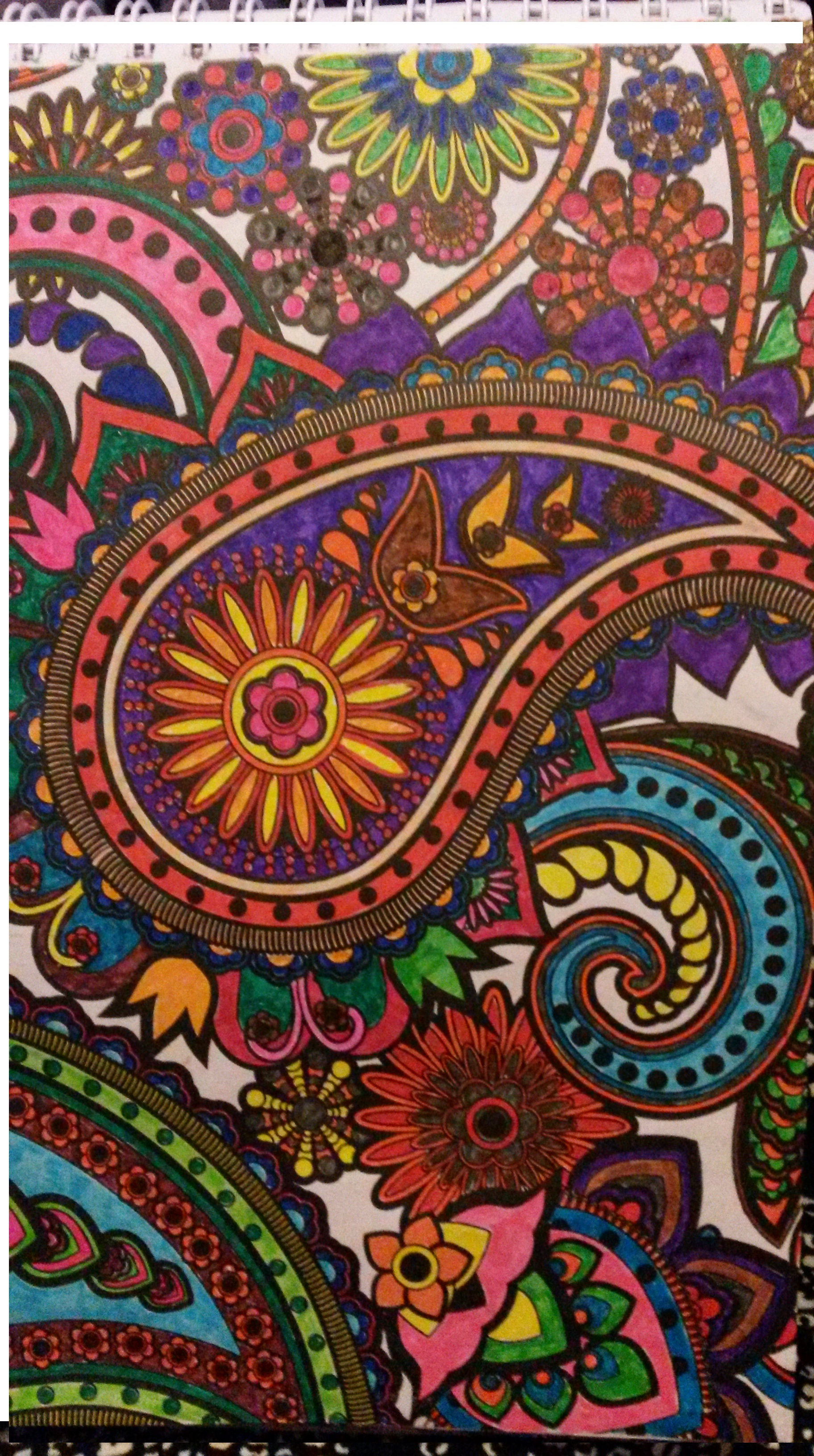
Currently, one of my preferred ways to relax whilst I’m alone at home watching TV or the like, is colouring in complex swirly patterns like this one. It can switch off some of the thoughts for a while, passes time and gives a creative focus outside of oneself, even a way to practice mindfulness. The results can even be used for something pretty, for instance, made into pictures or coasters. Seeing something lovely that you have managed to create, despite perhaps feeling depressed or low, can be encouraging. It is a relatively cheap hobby, especially as at the moment we seem to be fortunate that there is a range of “colouring books for grown-ups” around, often to be found in discount book stores / stationers’ / supermarkets. No doubt you could find template patterns on line as well, which could work if you have access to a printer. Then all that is required is a packet of crayons or coloured pens (note to self, curb tendency to multi-buy pretty pens!).

Happy colouring! 🙂

Ginny xx

Deeper Still

I feel so tired and cold inside today. Last night and this morning my emotions were rocking between extremes of sadness and anxiety and hurt and I cannot justify any of it. Now, even though I have done some nice things today and received some very good news, which really is a gift – I went to coffee group this morning so I was not on my own, and my offer of work was finalised which means I will have some form of financial security – despite all these things, instead of feeling thankful, I’m feeling scared, empty, useless, lost and numb. I’ve slipped into that cold state of feeling that I am only watching and desperately wishing I were not alone, sad but angry with myself at the same time.

These times make me doubt even more what’s really in my heart.

I’ve been listening to this prayer song :-

Deeper Still by Bebo Norman

She turned her head as if to hide, there was just nowhere to go. ‘Cause standing tall on every side, the mighty fear of letting go. She said, my God I’m so ashamed, thirty years a tragedy. I still believed that he could change, but he pulled me down like gravity.
He broke my will, but it’s deeper still, deeper still .

She told me morning was the time, when the sun burned bright and clean, and love grew fragile on the vine, all wrapped up in gold and green. ‘Cause after all we know we all are after all the same things – but for the sun no rain would fall, and it burned him up and turned him mean.
This fire that kills me, it’s deeper still, deeper still.
Tonight I rose up with the moon, and looking down from high above, I saw a world carved and confused into valleys deep in need of love, and falling down all thick with grace, Heaven’s cloud of mystery was filling every empty space, down to the depth of human need.
This love that heals, it’s deeper still.

Love that heals me, love that heals me, love that’s deeper still.

This love that heals me, it’s deeper still, it’s deeper still.

“Broke my will, but it’s deeper still; this fire that kills me is deeper still; and filling every empty space, Heaven’s cloud of mystery – this love that heals is deeper still.” This is the only thing that lets me carry on in these times. Without it I am nothing. The promise that no matter how black and cold it is in our reality of this moment, how matter how much we are hurting, no matter how much we fear what is within us, what is always deeper still is God’s love for us that created us to do good, God’s love that longs to fill us in every empty depth of our hearts.

I hate what I see that I am and the fight that goes on in my head and the frozen darkness that stops me seeing anything good. But this does not change the truth that God is love, God is beside us on this road, and the greater my emptiness and my need, all I have to do is cry out to Him, plainly admitting how things are and everything I cannot change. Then, deeper still, deeper still, will He come into my need and sustain me.

https://www.youtube.com/watch?v=xJ7g9Gf64ns – not my video. With grateful thanks to Marco Bonaccorso. From Bebo Norman’s album “Ten Thousand Days”.

Ginny xx

Sitting with uncertainty – Part 2

Sitting with uncertainty – Part 2

I apologise for not writing this Part 2 yesterday as hoped.  I had a weekend away for a very dear friend’s 80th birthday. It was special and lovely but I was very drained when I got home and I did not manage to write. I’m sorry.

***

I am starting to realise that it is terribly difficult for me when I realise that my thoughts or emotions are different from someone else’s about a certain situation or matter.  It could be about a particular situation or experience we are both sharing in right now, or a memory of something that happened before, or a matter of belief (religious belief, a principle, that kind of thing), or any case of sensing someone’s strong emotion. It was my therapist and someone else in a therapy group I’m part of who identified this first, then went on to identify that this difference of emotion/thought between individuals is another instance of uncertainty we must learn to sit with.

I sense other people’s emotions more strongly than my own. I find it hard to identify and name my own emotions. When I do feel them they can be very frightening and overwhelming; I may feel them so strongly that they block out anything else, becoming to me everything that there is, frightening me about what will happen and what it means about who I am. They can feel as if they physically pain me. I may feel physically utterly drained or consumingly panicked and driven, unable to sit still, pacing constantly for hours (compulsively, despite the physical pain this causes by aggravating my joint conditions). Times of overwhelming emotion are times I often self-harm.

Other times, I may feel numb and nothing at all. I may be painfully conscious that the other people I’m interacting with feel very strongly but I feel unable to reach out, to come to any connection with them. I may want to say something and know I should and know I should and want to empathise, but feel frozen and unable to respond, and know that by this I am hurting the other person still further.

Or, despite not knowing at all what I feel, I may feel the other person’s emotion (especially sadness, anxiety or anger) so strongly that beyond what I think would be described as empathy, I actually feel their emotion myself to a level that I cannot stand it. It can happen very fast and I do not make any conscious decision or any particularly strong attempt to pick up the emotion. It just happens. Sometimes, I have as little as passed people on the street, sat beside someone on the bus or had a minimal “meeting and greeting” interaction on the reception at work, and this wave or wall of emotion will hit me and stop me in my tracks. I passed someone on the street the other day and was suddenly hit by a wall of such strong anger and hurt that I stopped walking. It was like a physical presence around me and in my lower chest and I gasped and this was swiftly joined by extreme fear. The person had done nothing to me, not even noticed me nor interacted in any way.

A couple of people who share my religious faith have told me that it is a particular gift to be able to empathise to a particularly great extent – it could allow me to help someone, be there for them, pray for them, understand their needs, know if they are in danger, and so on. I think perhaps it can be a gift and could be something from which good can come. Not that I think I have any particular ability, certainly not any power, but it is a sensitivity that could lead to good.

The problem is the intensity is so great it is frightening – as frightening as my own emotions can me. It can be there to such an extent that I can no longer continue to be with the person / people, and withdraw completely in exhaustion and confusion and fear and feeling huge guilt that I cannot resolve what is happening to the person and can’t be sure – there’s the uncertainty again! – is it my fault they feel this way and how should I respond? Then I end up back in the numb place of then not knowing how to respond and not being able to give anything at all.

Whichever of these happens, I’m left unable to interact socially. I haven’t yet unpicked quite why sitting with the uncertainty of the differences and unpredictability of emotions between people is so very frightening and overwhelming to me.  However it does seem to be shared by several people I know who suffer with personality disorder.

A particular problem where thoughts, emotions, intentions and communication are involved is that you can never check enough. You can never get to be completely sure what the truth is and what is right or wrong and if you are good or bad.

In Part 1 of this post, I gave some examples of other kinds of anxieties in situations of uncertainty. All of these are around things that are more concrete, if that is the right word, where eventually you will find out some answer.  For example, to go back to the same examples I gave: tomorrow will come and I will find out what will happen, I can ask my friend which colour she prefers and be sure to choose the mug that colour, and in time I will eventually find out the interviewer’s opinion of me and whether I get the job or don’t. If I’m trying to overcome an obsessional activity or belief, for example, if I don’t wash my hands 10 times before I speak to my friend she will get sick because of me, it is possible to test out this belief in the concrete world – it will be extremely distressing to me at first and cause a huge amount of anxiety, but I can if I dare to, not wash my hands 10 times the next time I speak to my friend and see what happens. If she does not get sick, and if I dare to keep testing this out, eventually perhaps I may be able to see that I do not need to keep doing this ritual to keep my friend safe and I will be able to stop washing my hands so much. I have suffered and still do suffer to some extent with this kind of obsessional checking and in the past, CBT therapy I’ve tried has focussed on changing behaviour and seeing that the awful things I fear do not come to pass.

But where the internal world of thoughts and feelings are concerned, I find it is not possible to check or “see what happens” in the same way and I never find peace.

For example, in the above instance I can see at least to a large extent without doubt that my friend does not get sick physically. But if I am fearing that I have hurt someone emotionally, how can I be sure? If I ask them, how can I be sure they are not just saying something to reassure me? If I think that someone is having a particular thought or a particular emotion, can I be sure that I got it right? Often it’s harder to ask in these situations (and I suppose I feel that it would be socially inappropriate to do so in many situations – I don’t want to inconvenience other people with my own obsessions and fears). If I say something, can I be sure that the other person understood it the way I meant it?

Often, if I have said something that I intend as encouraging, helpful, etc, I worry afterwards that I have communicated a message that I did not intend, which is bad and that is going to be terribly hurtful and upsetting to the other person because they will get that message rather than the one I intended. Then I worry that I actually, unbeknown to myself, subconsciously intended and thought the bad interpretation, and that’s why I said what I did. This must show that I’m actually evil and nasty and need to punish and hurt myself to make sure I don’t hurt anyone else. Then I will self-punish or self-harm. For example, a friend was worried about her baby girl who could not be with her during her medical appointment, and was instead with a babysitter in the waiting room outside. I said to her something like, “It looks like she is with someone who’s looking after her very well,” intending to reassure my friend that her baby was well. Immediately I’d said it, I panicked that this sentence could have implied “she’s with someone who’s looking after her well, because you don’t” and that my friend would think I was saying that she didn’t look after her baby properly. And my mind spiralled out of control thinking that although I didn’t know it, I was really being nasty to my friend and judging her as a bad mother and my intention, although I thought that I wanted to encourage my friend, was actually to upset her because I’m such a bad person inside. I wanted to check with my friend and say, oh no no I didn’t mean this, I meant… etc, etc, but I didn’t dare to, in case that would only make it worse, because if she had not seen the bad interpretation, it would only make it even worse to mention it. I felt the desperate urge to self-harm immediately to punish myself for being so bad inside.

In these kind of instances, nothing whatever will ever reassure me as to what my intention or thoughts really were (whereas, in the earlier example about obsessional hand-washing, I could obtain the concrete proof that my friend did not get sick). There is no way to check for certain what my real intention was, that it is not unconsciously something terrible which I’m not aware of and can’t control. There is no way to check for certain what effect emotionally I’ve had on someone else, or what they have understood from something I have said.

So I don’t know what the way out is.

For some reason, self-harm does seem to be the only (maladaptive) way that I do cope with this kind of uncertainty. When I can’t check enough that I’m not actually doing bad, or intending bad, then I have to hurt myself. The one thing that does seem sure is that if I’m doing something to hurt myself, it will somehow keep other people safe, because I can make sure I’m hurting myself, not other people. I can make sure I’m punishing the evil greedy part inside me so that it doesn’t burst out.

I don’t know how to begin to deal with these kinds of uncertainty. In time I think I am going to give this a Part 3, to look at ways of trying to sit with uncertainty in communicating with people. I’ve a feeling that it’s going to be an important part of my therapy as so much of my interpersonal problems, and perhaps for others with personality disorders too, are connected to these themes.

Thank you for reading, as ever.  I would love to hear your thoughts and experiences and what you find good, or difficult, in interactions with others and in communicating about emotions.

Also, an important note: I know that in this article, I have contrasted examples of anxieties and obsessional thoughts surrounding what I have referred to as things I can check in the concrete, external world, with obsessional thoughts and fears about what is going on in one’s head / emotionally / internally. I say that it is harder for me to find the way out of the latter obsessional thoughts and fears. Please note that in no way do I wish to belittle or minimise the distress experienced by those who are struggling with OCD thoughts and actions and fears relating to the external world, for example checking doors or switches, or cleaning. I know from my own experience and from hearing loved ones’ experiences, that these struggles are deeply distressing and the thoughts just as consuming. I empathise very much with what you are going through. All I wished to do here is draw a distinction which I have come to in my own mind and to suggest that the way out of the two sides of these obsessional thoughts may perhaps be different. As I’ve said from the start, I am neither a clinician nor medically trained, and these are just my own thoughts.

Ginny xx

“What did we do in the War?” (and other unexpected questions…)

“What did we do in the War?” (and other unexpected questions…)

Just a little lighter-hearted anecdote…

If you’ve read “Not working out” you’ll know that I’m looking for a new job at the moment; something that I can do part time and that I might find less mentally stressful and less triggering to my obsessional thoughts and voices.

I’ve applied in several stores and I went to an interview today for a sales assistant position in a family / fashion high street shoe store. I always try to do some preparation before an interview to find out about the business but I have to say that in this case I was totally unprepared for this question out of the blue, “So, what did we do in the War?” ! Not your typical interview question when applying to work in a shop?!

Just wondering if any of you have any funny / puzzling interview stories? I enjoy these unexpected and funny sides of every day life no matter how small. They give a bit of lighter-heartedness and make us laugh even when things are rough. Which is important to hold on to.

A psychiatrist once told me that when we struggle with anxiety, it is like a bucket filling up faster and faster with water inside us and weighing us down or we feel we are drowning under it. We can’t tip the bucket over and we can’t stop the flow of water when we’re struggling with anxiety and depression and fear but we can do little things to punch holes in the bucket and let some of the water drain out so that we can live a little bit more easily. Humour is one of the things that’s good at punching holes in the bucket.

(And in case you were wondering, the answer to today’s question was that they made Army boots. Didn’t get that one right but some of the rest of the interview went okay and even felt like a good conversation in places, dare I say it, so perhaps I can hold out some hope. I’ll find out next week.)

Wishing you as good a day as possible. (Perhaps I’m practising for my store job. “Have a nice day now…” ;-)….)

Ginny xx


An early morning surprise visitor

It had been the most horrible night, with repeated flashbacks. I felt surrounded by danger and panicky emotions boiled to the surface and repeated self-harming had only numbed it for a few minutes at a time.

I was exhausted but gave up on going to sleep in the early hours as I knew I’d soon have to get up for work.  As it got lighter, I was in a numb state where I was not sure any more if things were real or if I was watching everything through glass (this happens to me sometimes after an intense period of distress).  I was standing staring out of the window into the communal garden.

Suddenly, the tiniest little deer (muntjack?) came walking very slowly and calmly across the lawn.  He stopped to nibble some grass and stood for several moments looking around before, just as calmly, walking on and following the path round the side of the building out of sight.  He showed none of the timidity deer often have round people and what he was doing so far into the city centre, I don’t know.

Coming after the strain of that night, it was a most precious moment.  I don’t know what I felt.  It seemed ethereal.  Just I knew I was not quite so numb and disconnected the rest of that day, and I often think back to that little deer, walking in the early morning.

There really are beautiful and unexpected things everywhere, no matter how much pain we are feeling. Perhaps the times we are startled into watching them and drawn out of the pain by their beauty, will help our recovery.

Ginny x

A shapeless piece of steel… a burn that burns much deeper – “Why do you self-harm?”

I have written this post in answer to the question I was asked of why do I self-harm and what purpose does it serve. In my opinion it definitely serves an important purpose and it is not a “cry for help” or to get attention as stereotypes hold.  It’s a coping strategy – a harmful, or “maladaptive” one, but it’s a strategy.

It’s necessary. It’s the only way to carry on. It’s a compulsion, a need, and a blessed release.

It can be almost grounding. When the voices are screaming, the guilt is exploding in me, I am crushed by anger and fear and disgust at myself and running out of breath – I know what those cuts will feel like. It’s the same every time. It’s release. I know exactly what will happen no matter what a mess everything is. I get the scissors or the razor and I know what I must do and I know what I will see as I scratch and bleed and I know what I will feel, the familiar sting, redness, throbbing. I know what that is. There it is before me and it can’t be doubted.

It’s better pain than what’s in my head and it stops the noise and hurt and racing thoughts and voices and rising anger and crushing terror and revulsion that wants to tear at my skin to get away all the bad that I know is inside me.

I can be sure that I’ve hurt myself. There it is, I can see it. It’s not good enough. I’m very weak. I need to do it more and more. But it’s something. It’s some way I can be sure I hurt myself, so I won’t hurt someone else. So I’m not such a danger to everyone else. Not so disgusting.

Sometimes it’s so that I can continue with the day.

It shuts off, for a few minutes, the frightening memory, the frightening emotion or the disgusting thoughts. Especially violent anger or the sadness that blacks everything else out and hides everything good. It literally cuts through it, a little bit, fights the way upwards.

It can end some of the dangerous dissociations where I lose time, forget things, make irrational decisions, disappear from reality into my safe escape worlds.

Perhaps sleep will come afterwards.

Perhaps numbness or quiet will come afterwards and it’s a little bit of a way to get a break.

People say it’s a cry for help. It’s not. It’s not something I threaten to do to get my own way or pressure people. It’s secret. It is the help. It is the way to keep going. If I couldn’t do it, I’d have had to die a long time ago. I’d have given in and (though it’s against every single one of my personal religious and moral beliefs when I’m in my rational mind) the darkness would have consumed everything and I’d have had to do it. I hide it from everyone, make sure I do it where they can’t see, and I very reluctantly tell my therapist about it. One of my friends says call her when I feel I’m going to do it, she’d want to know. I could never do that – I would not want to put her in the position of feeling she must stop me.

I don’t think I do it very “badly” – several people in one of my therapy groups have far worse self-harm scars than I do. It’s nothing really, it’s no danger.  But it is a way to cope.

***

“…My dreams are not the issue here, for they, the hammer holds. The hammer pounds again, but flames I do not feel, this force that drives me helplessly through flesh and wood reveals a burn that burns much deeper, it’s more than I can stand…”

(This and the title quote are from Bebo Norman’s The Hammer Holds. For some reason this song always makes me think of how I feel when I self-harm.  I know this is not anything to do with the original meaning of the song and Bebo Norman is not making this reference at all (it’s a Christian song telling the story of the Crucifixion). Yet some of the lines express how I feel when I cut.  It’s a way to bear the pain; it’s something I wish did not have to be but is absolutely needed and drives me on, it’s the only way to live at the moment. )